Where to stay in Rhodes?
The largest of the Dodecanese islands, with all the quiet authority of an older sister, Rhodes is also one of the brightest corners of the Aegean. It is known as the “Island of the Sun”, and it is not just a slogan: light slips in everywhere, bouncing off medieval walls, the whitewashed facades of villages and bays whose water looks almost unreal, for most of the year.
It is though very touristy attracting package tourists. But it has many hidden spots especially on the east and western coast where you will find authentic places to stay and cosy tavernas. Just avoid the hotspots.
The walled capital, with its stone alleyways and hidden courtyards; white villages looking out to sea; small rocky coves with turquoise water and long sandy beaches. Summers are hot and dry, winters mild, with a few wild corners where the only sound is the wind.
In this carefully chosen selection, created for travellers who value authenticity above all, there are guesthouses within the city walls, small hotels by the harbour, villas with pools hidden among olive groves and whitewashed cottages that feel like love nests, as well as villas that work beautifully for families in rural areas or near the sea. These are places with real character in Rhodes that make any stay feel more genuine and more unforgettable.
• Guesthouses, B&Bs and hotels near the sea
• Villas and holiday homes with sea views or in the countryside
• Romantic escapes, wellness retreats and “adults only” hotels
Our favourite villages and best places to stay in Rhodes
Rhodes Town: between medieval walls and a cosmopolitan harbour
Rhodes Town has two sides that watch each other out of the corner of the eye. Inside the walls, the Old Town is a maze of cobbled lanes, tiny squares and courtyards where bougainvillea climbs over the facades. Early in the morning the echo of footsteps on stone and the clatter of a shutter being raised are all that can be heard; during the day the bustle is intense, and those seeking calm tend to continue their route. At night, tavernas light up the arches and the air smells of charcoal and grilled fish.
Outside the walls, the New Town faces the sea. Art deco buildings, lively cafés, design shops around Mandraki harbour and the seafront promenade create a far more urban atmosphere, at times almost Mediterranean-Italian. From here there are beaches, boats offering short cruises or trips to other islands, and a good bus network for exploring the rest of Rhodes without a car.
As a base, it is very convenient for anyone wishing to combine history with a bit more movement. In the streets, old stone mansions have been converted into small hotels, some quite luxurious, others more modest, closer to a B&B. There are inns with inner courtyards where breakfast is served under a lemon tree and a handful of design-led places near the harbour, created for travellers who like to have everything within walking distance.
Lindos: white postcard beneath the Acropolis
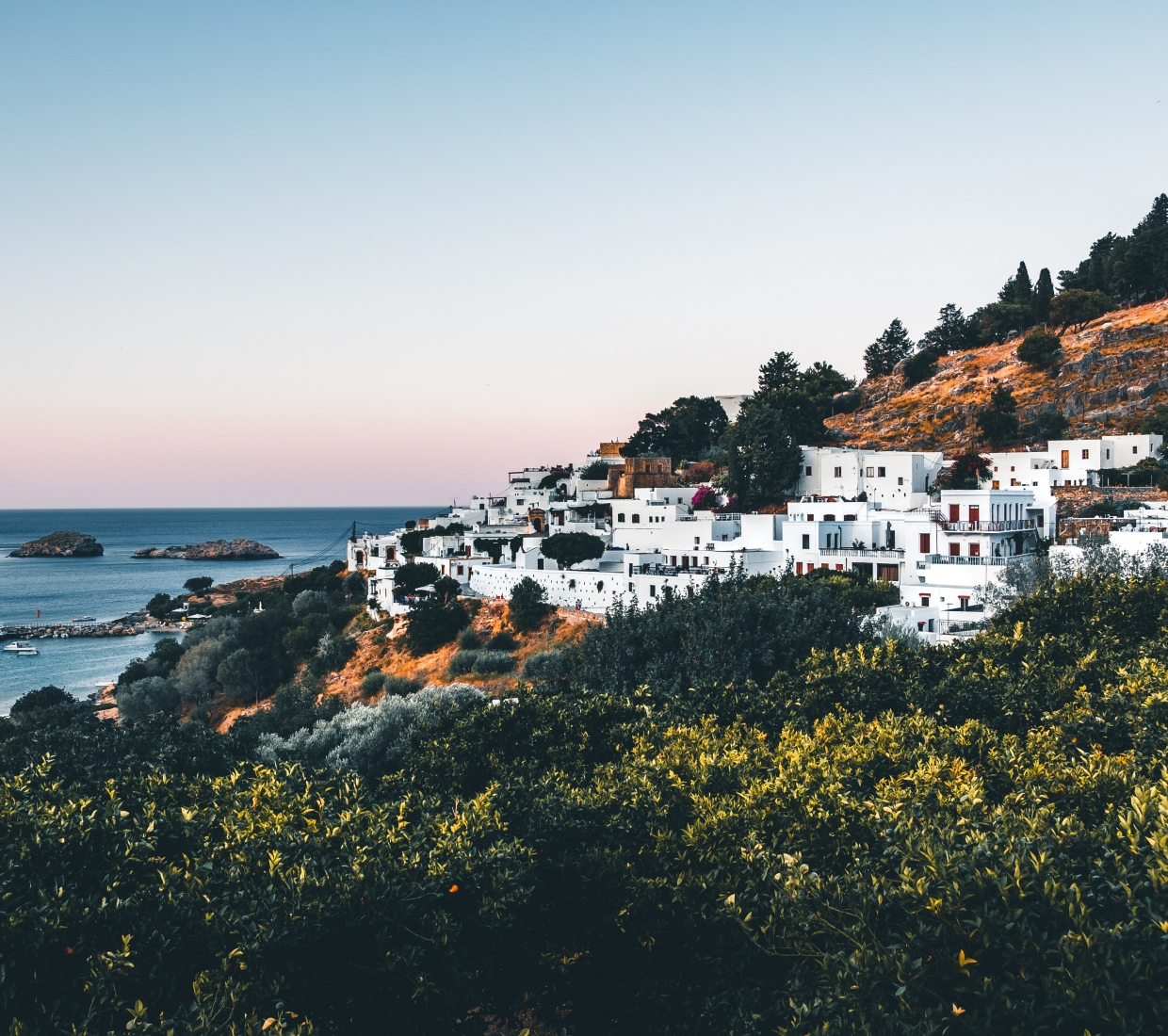
Arriving in Lindos is always a small shock. From the road there appears only a white patch spilling down the hillside towards the sea and, above it all, the Acropolis cut out against the blue sky. Once inside, the village welcomes visitors with narrow lanes, pebble-paved courtyards, wooden doors that open onto traditional houses and bougainvillea that almost hides the facades.
By day, the beaches of Lindos Bay and small Pallas Beach move to the rhythm of the sun and long swims. Towards evening, many people climb up to the rooftop terraces for a drink before dinner; the rooftops fill with low voices and, in summer, the village regains something of the bohemian mood of the 1960s, when it was a refuge for artists and hippie travellers.
Lindos is especially popular with couples who are looking for a romantic atmosphere, and with those who dream of waking up to a view of the Acropolis from the terrace or walking barefoot down to the sand. Small hotels within the village work particularly well here, with terraces facing the sea or the ruins, suites in traditional houses with private courtyards and a few places right on the beach, where life runs almost entirely between the village and the shore.
Ialyssos and the west coast: breeze, sport and sunsets
Ialyssos is a small seaside town on the west coast of Rhodes, just a short drive from Rhodes Town and the airport. It has a long seafront promenade, beaches of pebbles and some sand, and an almost constant breeze in summer, ideal for windsurfing and kitesurfing. Inland, the town offers tavernas, small squares and a distinctly local feel, making it a practical base for combining sea, sport and cultural visits.
The beaches stretch for kilometres, part pebble, part sand, and are ideal for swimming, reading on a sunbed and watching the sky turn orange at sunset. Further north, near Rhodes Town, stretches of coastline become more urban, with every service at hand, yet there is always the option of slipping away to a quieter cove when silence is more appealing.
It is a very convenient area for travellers who want to mix sea, sport and sightseeing without spending too much time behind the wheel. Think small seaside hotels, discreet resorts that do not dominate the landscape and family-run places from which it is easy to reach both the town and the airport. Days here often begin in the water and end with a simple dinner in a taverna in the upper part of the village.
East coast: Faliraki, hidden coves and Kalithea Springs
The east coast offers warmer, generally calmer waters. Faliraki is probably the best-known name, with a long sandy beach, a lively atmosphere in high season and plenty of entertainment options. But that is only part of the picture: as soon as the road continues a little further, small rocky coves of transparent water appear, perfect for an early-morning swim or snorkelling once the sun is high.
Very close by are the historic Kalithea Springs, an elegant complex of architecture, pergolas and gardens facing the sea, with an almost cinematic air. The contrast between the rocks, the deep blue water and the white buildings turns even a quick coffee into a small ritual. It is an ideal place to spend the day between swims and gentle walks.
Along this stretch of coast, small boutique hotels sit literally on the beach, some with private steps leading down to quiet coves, alongside wellness hotels where the spa faces the sea and the pace slows naturally. A little further inland, villas with gardens and private pools are perfect for families or groups of friends seeking their own space without giving up proximity to the water. It is a very comfortable area in which to settle for a few days: the sea is usually calm, everything lies close at hand and, just a short drive away, there is always a historic village, a market or an interesting spot that adds a cultural note to the journey.
Prasonisi: where two seas meet
At the southern tip of Rhodes, Prasonisi feels almost like the end of the island. Here the Aegean and the Mediterranean meet and form a sand spit that changes shape with tides and wind. One side is usually wilder, with waves and gusts that attract windsurfers and kitesurfers from all over the world; the other is calmer, with flat water where people learn, swim or simply watch the play of sails and kites on the horizon.
In high summer, the atmosphere is relaxed and sporty. Vans, boards resting on the sand, surf schools and clothes drying in the sun set the scene. At night, when the wind drops and the surfers retreat, the silence is almost total and there is a real sense of being far from everything, surrounded by sea on all sides.
Accommodation here is generally simple: studios and small beach hotels offering just what is needed for a good night’s sleep before heading back to the water at dawn. Many travellers combine a few action-packed days in Prasonisi with quieter stays inland or in villages such as Lindos or Rhodes Town.
Valley of the Butterflies (Petaloudes): a green refuge
When the heat builds up along the coast, the Valley of the Butterflies offers a different kind of summer. The air is cooler, scented with resin and water, and the landscape changes in an instant: wooden bridges, walkways, small waterfalls and deep shade under the trees. In the warmest months, thousands of butterflies cluster on trunks and rocks, creating the feeling of entering a place that asks for quiet steps and low voices.
It is a perfect excursion to punctuate several days on the beach, particularly for families or anyone in the mood for a gentle walk. Paths are well signposted and, every so often, benches, viewpoints and tiny chapels appear along the way.
In the surrounding area, both inland and towards the west coast, small rural hotels and guesthouses among olive groves and citrus orchards work very well. These are simple, often family-run places for travellers who prefer to wake to birdsong rather than traffic.
Archaeological west: Kamiros and the mountain villages
The western coast of Rhodes has a quieter, less touristy air, as if the island had stepped slightly aside from the noise. Here lies the ancient city of Kamiros, with its grid of streets, cisterns and temples that allows visitors to imagine what life was like when this was an important hub of Mediterranean trade. Walking among the ruins, with the sea in the background, makes the island’s history more tangible.
Further inland, the road climbs through forests and hills to reach mountain villages where time seems to move at a different pace. There are squares shaded by plane trees, tavernas serving simple traditional dishes, small family wineries producing wine on a small scale and viewpoints from which the sea appears closer than the map suggests.
This area tends to attract travellers with an interest in archaeology, ancient history and the more rural side of Rhodes.
What to do in Rhodes: nature, culture and sea
Rhodes invites movement, but without haste. Those who enjoy walking will find hiking routes and cycle tracks that cross the green interior, through pine forests and olive groves, with small churches, viewpoints and villages where there is always a taverna ready to restore energy. Spring and autumn are particularly pleasant for these outings.
The sea offers another perspective on the island. Kayak trips, boat excursions and snorkelling reveal coves that cannot be reached by land, cliffs that fall straight into the water and corners where the only sound is the dip of the paddle. From several of the selected places to stay, it is easy to arrange short excursions of a few hours or at sunset.
The cultural side goes far beyond the Medieval City. In addition to the museums and palaces of the capital, there are archaeological sites such as Kamiros, monasteries perched on hilltops and remains from different periods that turn the island into a small open-air history book.
Wine lovers can follow an informal route through wineries working with local varieties and producing fresh white wines that go particularly well with seafood. Increasingly, there are also hotels offering wellness experiences by the sea, with spas, yoga classes and simple treatments designed so that guests arrive tired and leave feeling quietly renewed.
It is well worth visiting at least one winery offering tastings – for example Emery, Kounaki or Alexandris – to understand better how climate and soil shape the character of the island’s wines. And for those drawn to local markets, places such as the Nea Agora in Rhodes Town, with stalls piled high with fruit, spices and regional products, provide an easy way to take a piece of the island home: olive oil, honey, dried herbs – and the memory of a morning spent among voices, colours and Aegean aromas.
When to go
The best times are generally May, June and from late September to October: the weather is pleasant, the sea is warm enough for swimming and there are far fewer people than in July and August, when both temperatures and visitor numbers rise considerably.
Beaches worth the detour
Anthony Quinn Bay and Ladiko: small rocky coves with emerald-green water, perfect for snorkelling. Insider tip: it is best to visit early in the morning or late in the afternoon; by midday the excursion boats arrive and it fills up quickly.
Tsambika: a long beach of golden sand and shallow, calm water, ideal for long swims without waves. Insider tip: early risers can walk up to the small chapel on top of the hill before heading down to the beach; the views along the coast are spectacular and there is usually hardly anyone there.
Our collections
Don’t know where to go? Let our collections inspire you.